
CMMC self assessment liability is increasing as government-led DIBCAC oversight expands and contractors certify compliance under CMMC 2.0.
Microsoft Copilot federal deployment requires authorization, data-boundary, security, and governance decisions before an agency begins a pilot or organization-wide rollout.
A common reading of the current CMMC position runs as follows. Third-party certification was paused in July 2026. Level 1 and Level 2 can be satisfied by self-assessment under the deviation now in force. External verification is therefore less likely, so a contractor's exposure has decreased.
The arithmetic in that reasoning is wrong, and the error is specific. Two independent organizations verify compliance against NIST SP 800-171. One of them, the CMMC Third-Party Assessor Organization community, is paused. The other, the Defense Industrial Base Cybersecurity Assessment Center (DIBCAC), is not. Government-led assessment authority was explicitly preserved under the February 2026 class deviation and carried into Revision 3 in September.
The change is therefore structural rather than quantitative. One route to verification stopped. The other continued. For a contractor, this does three things to the risk picture, each covered in this article: it shifts the attestation burden onto the contractor's own signature, it moves the triggers that determine who gets verified, and it raises the standard against which an inaccurate statement is judged.
Who Still Verifies Compliance
The simplest way to see the shift is to list what each organization does.
| Assessment type | Who conducts it | Current status | Who initiates |
|---|---|---|---|
| Level 2 self-assessment | The contractor | In force under the deviation | The contractor, annually |
| Level 2 C3PAO certification | An accredited third-party assessor | Paused as of July 13th, 2026 | The contractor, by appointment |
| DIBCAC Medium assessment | DIBCAC, under the Defense Contract Management Agency | In force | The government |
| DIBCAC High assessment | DIBCAC on site | In force | The government |
| Joint Surveillance Voluntary Assessment | DIBCAC, by contractor request | In force, subject to DIBCAC capacity | The contractor, with government acceptance |
Two features of that table matter more than any individual row.
- Government assessment survived the suspension by design. The clause that preserves the authority to conduct Medium and High assessments was carried from DFARS 252.204-7020 into the renumbered DFARS 252.240-7997 effective February 1st, 2026, and the September 3rd class deviation preserved it again. This was explicit rather than incidental.
- DIBCAC assessments are not procured. A contractor cannot schedule a Medium or High assessment to prove its position. The closest available step is a Joint Surveillance Voluntary Assessment, which requires government acceptance and depends on DIBCAC capacity. In practical terms, the government chooses who gets verified.
Context on the renumbering and what the current clauses require is covered in our article on the clause numbers changed, and the broader status of CMMC is in our article on the CMMC Reform Task Force report.
The Attestation Burden Moved Onto One Signature
When a third-party assessor validates an environment, an independent party shares responsibility for the judgment. Removing that assessor from the process did not remove accountability. It concentrated accountability on the contractor's own attestation.
Three obligations that produce that attestation remain in force exactly as before. A current self-assessment score must be posted in the Supplier Performance Risk System. The score and the compliance posture must be affirmed annually by a senior official named for that purpose. The underlying 110 requirements of NIST SP 800-171 Revision 2 continue to apply, and DFARS 252.204-7012 continues to require adequate security and cyber incident reporting.
The affirmation is a legal certification by a named individual, not an administrative task that can be delegated. That distinction, and the accountability chain behind it, is covered in detail in our article on who signs off when AI writes the control narrative. The relevant point here is that the suspension produced no new signatory and relieved none of the signatory's exposure. It removed the party that would have independently validated what the signatory attested to.
How DIBCAC Decides Who Gets Assessed
This is the mechanism most contractors do not examine, and it is where the suspension does its real work.
DIBCAC selection is not random in the ordinary sense. Several documented factors influence which contractors are chosen for Medium or High review.
- Prior self-assessment scores reported to SPRS. DIBCAC can review posted scores when identifying candidates. A high score communicates that the contractor claims strong compliance, which is a statement the government can test rather than a reason to defer testing.
- Contracting officer request. A Contracting Officer can request a government-led assessment during source selection or during performance where the stakes warrant it.
- Whistleblower referrals. A complaint from a current or former employee can prompt an assessment. The False Claims Act creates specific incentives for such complaints, which are covered below.
- Risk-based sampling. Industry-wide sampling occurs, often weighted toward contract value, information sensitivity or sector risk, rather than selected uniformly at random.
- Follow-up on prior findings. A contractor with earlier assessment deficiencies is more likely to be reassessed than one with none.
Two consequences follow, and together they invert the common assumption that a high score reduces audit risk.
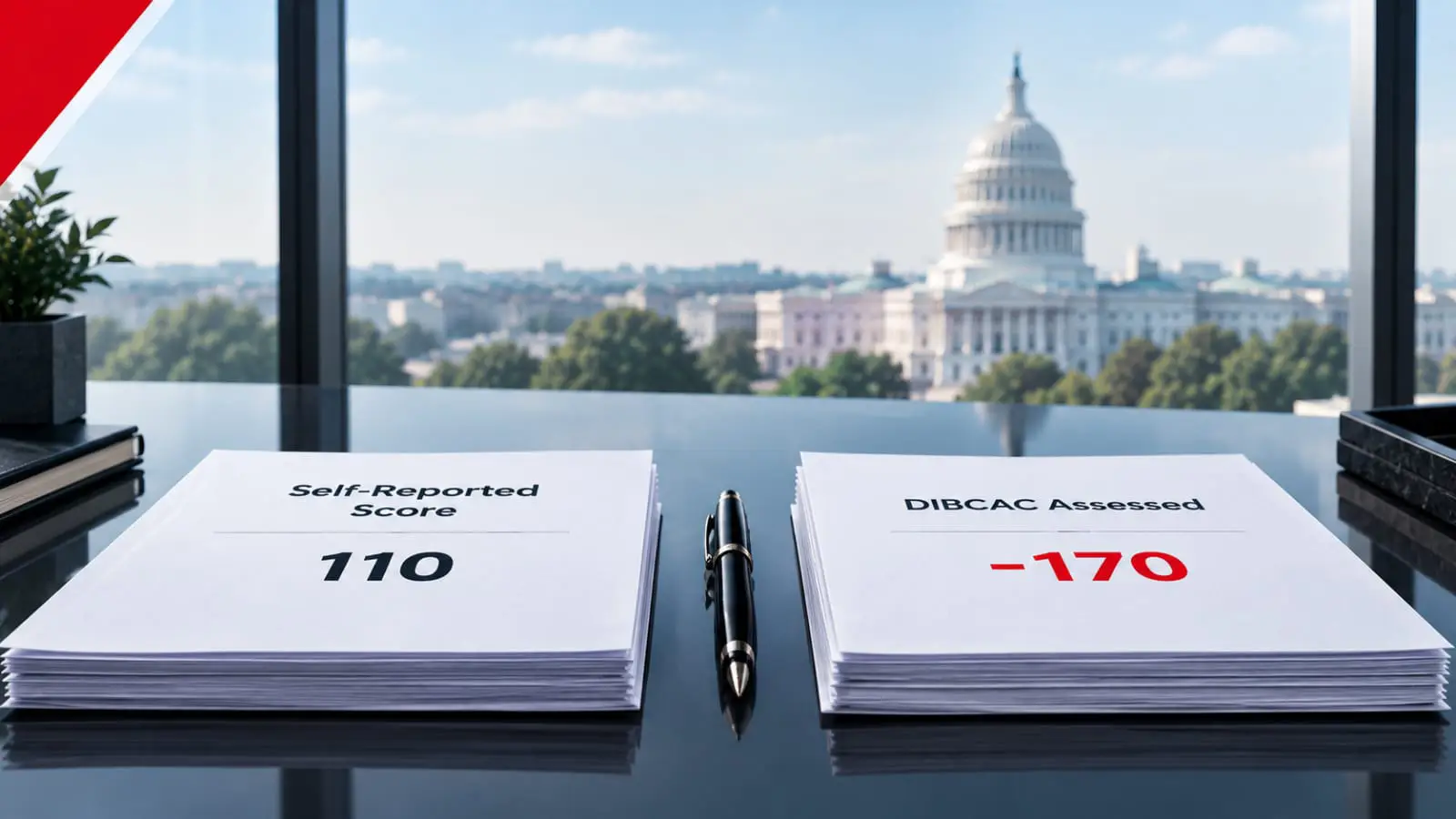
- The score is bait as well as evidence. A posted score at or near 110 claims substantial compliance. Where a government assessor later finds a materially lower posture, the gap between the two numbers is the evidence. Previous settlements have involved exactly this pattern: a self-reported 110 and an assessed negative 170 in one matter, a self-reported perfect score and alleged non-compliance across nearly four years in another.
- A Medium assessment can become a High assessment. DIBCAC retains discretion to escalate a Medium review to High if the Medium surfaces concerns. A contractor who prepared for the lighter examination may encounter the heavier one.
What this changes for a contractor
A high SPRS score is not a shield. It is a representation to the government about the state of the environment, and the government has the authority and the mechanism to verify it.
An inflated score creates visibility, not safety.
What the two government assessments actually involve
| Element | Medium | High |
|---|---|---|
| Format | Conducted virtually | Conducted on site, with 30 days of advance notice |
| Scope | Review of the System Security Plan and supporting documentation, with discussion | Thorough examination of implementation against the NIST SP 800-171A assessment procedures |
| Confidence level recorded in SPRS | Medium | High |
| Can be escalated | Yes, at DIBCAC discretion | N/A |
| Supersedes self-reported score in SPRS | Yes | Yes |
The last row is the one that bites. Where a DIBCAC assessment is performed, its result is posted to SPRS and becomes the record of record. A contractor who posted a self-reported 110 and receives a DIBCAC-assessed 70 now carries both figures in a public record visible to Contracting Officers during source selection.
The Standard Against Which the Signature Is Judged
The suspension changed how compliance is verified. It did not change the law against which a knowingly inaccurate attestation is measured.
The False Claims Act reaches statements material to a federal contract payment, including cybersecurity representations made to obtain or retain contract eligibility. The feature that frequently surprises contractors is the standard of knowledge. The statute does not require intent to deceive. It covers statements made with actual knowledge of falsity, in deliberate ignorance of the truth, or in reckless disregard of the truth. A signatory who could have confirmed accuracy and did not is exposed under the third branch.
That exposure now runs through a smaller number of attestations. With C3PAO certification paused, the attestations in regular circulation are the annual affirmation, the SPRS score and representations made in solicitation submissions. Each is a candidate for later examination.
Enforcement patterns of the past year illustrate how this plays out. One settlement in 2026 arose from a government-initiated assessment that produced a score substantially below the posted self-assessment. A second arose from a former-employee whistleblower complaint and alleged non-compliance across nearly four years, with no security breach involved. In both, the gap between the documented position and the actual position was the issue, not an incident.
What Reduces the Exposure
Four actions reduce the gap between the attested position and the assessable position. None depends on the reform review returning third-party certification.
- Treat the SPRS score as a representation that may be verified. Reconcile it against an honest assessment of the current environment. Where the two figures differ, correct the posted score and record the reasoning behind the correction. Correcting a score is substantially less costly than having the discrepancy identified by an assessment or a complaint.
- Prepare for the Medium rather than for what the contractor hopes to encounter. A Medium assessment reviews documentation and discusses it with personnel. The documentation should describe the environment as it is, with evidence traceable behind each statement, and the people interviewed should recognize their own operations in it. A rehearsal in the form of a mock assessment surfaces the same problems in a controlled setting.
- Build the evidence path, not only the control. Implementing a control and documenting its implementation are two separable tasks. Government-led assessments test whether evidence exists to support claims, not only whether a control is theoretically in place. An environment where a reviewer can produce the artifact behind a given statement in seconds is positioned for either Medium or High review.
- Decide the Affirming Official knows what they are signing. The affirmation names an individual, and the ability to defend each statement under scrutiny is the practical defense against the reckless disregard branch of the statute. If the signatory cannot explain the basis for a specific control statement, that statement is where attention is required.
For contractors still establishing which assessment type applies to them, that determination follows the information handled rather than the clause number, and is covered in our article on who actually needs CMMC Level 2*.
How KSG Approaches This Period
Kaizen Solutions Group has secured federal and state government systems since 2016. We are an SBA 8(a)-certified small disadvantaged business, ISO 27001:2022, ISO 9001:2015 and ISO 20000-1:2018 certified, and we hold GSA HACS designations across all five categories: Risk and Vulnerability Assessment, High Value Asset assessment, Penetration Testing, Incident Response, and Cyber Hunt.
Our position on self-assessment is that it should be conducted as though a government assessor will arrive next week. The methodology, the evidence, the documentation and the people interviewed should hold up under the same scrutiny the Medium and High assessments apply. Treating self-assessment as a reduced bar is where the exposure accumulates.
Where we typically begin
- SPRS score reconciliation. We assess the environment against all 110 NIST SP 800-171 controls and compare the result to the score currently posted. Where those two figures differ, we address that first because it is the gap a government assessment would expose.
- Mock assessment aligned to the DIBCAC methodology. We walk the environment, documentation and personnel interviews against the Medium assessment procedures, with escalation points identified in case a review would be likely to go to High.
- System Security Plan and POA&M development. We produce and update documentation that describes the environment accurately, with evidence traceable behind each statement, which is the standard that holds up under government-led review.
- Risk Management and POA&M analytics. We deliver continuous monitoring, vulnerability and patch management, Cybersecurity Supply Chain Risk Management, and Key Risk Indicator and Key Performance Indicator dashboards, so that remediation progress is visible rather than inferred.
- Security operations and remediation delivery. We support Security Operations Center monitoring, SIEM and SOAR, penetration testing, incident response, Identity and Access Management, endpoint detection and response, and DevSecOps.
- Governance, Continuous ATO and Continuous Monitoring. For contractors that also carry FISMA and Assessment and Authorization obligations on the civilian side of their portfolio.
A useful place to begin
One question establishes most of the current exposure. If a Medium assessment were scheduled for sixty days from now, which of the 110 control statements in the current System Security Plan would the organization want to look at first?
That answer identifies the statements the Affirming Official is currently signing without a reasonable basis to defend them.
Talk to our team · Download our capability statement · Explore CMMC Level 2* readiness
Frequently Asked Questions
Can a contractor request a DIBCAC assessment?
Not for a Medium or High review. Those are initiated by the government and are not voluntary. The closest available option is a Joint Surveillance Voluntary Assessment, which requires government acceptance and depends on DIBCAC capacity. Many contractors instead engage external support for a mock assessment, which carries no official standing but surfaces the same findings in a controlled setting.
How are contractors selected for a DIBCAC assessment?
Through several documented channels: review of prior self-assessment scores posted in SPRS, Contracting Officer request, whistleblower referral, risk-based sampling weighted by factors such as contract value or information sensitivity, and follow-up on earlier assessment findings. Selection is not uniform random sampling, and the mix of triggers is published rather than opaque.
Does a high SPRS score reduce the probability of a government-led assessment?
Not reliably, and the opposite effect is plausible. A high posted score is a representation of strong compliance that the government has the authority and the mechanism to verify. Where a later assessment produces a materially lower result, the gap between the two figures is the problem rather than the lower result on its own. A high score is not a shield.
What is the difference between a DIBCAC Medium and High assessment?
A Medium assessment is conducted virtually and consists of a thorough review of the System Security Plan and supporting documentation, with discussion. A High assessment is conducted on site with at least 30 days of advance notice and applies the NIST SP 800-171A assessment procedures to test implementation against the documentation. The resulting score is recorded in SPRS with a confidence level reflecting the format.
Can a Medium assessment turn into a High assessment?
Yes. DIBCAC retains discretion to escalate a Medium review to High where the Medium surfaces concerns. Contractors should prepare their documentation and the personnel who will be interviewed to hold up under either depth.
Who conducts Level 2 assessments now that Phase 2 is suspended?
For Level 2 (Self), the contractor conducts the assessment and posts the score to SPRS. Level 2 (C3PAO) third-party certification is paused under the September 3rd, 2026 class deviation. Government-led Medium and High assessments by DIBCAC continue regardless, under DFARS 252.240-7997. Where a DIBCAC assessment is performed, its score is posted to SPRS and takes precedence over the self-reported figure.
What is the “reckless disregard” standard under the False Claims Act?
The statute reaches statements made with actual knowledge of falsity, in deliberate ignorance of the truth, or in reckless disregard of the truth. The third branch is the one that matters for self-assessment: a signatory who could have confirmed a statement's accuracy and did not is exposed, regardless of whether they believed the statement was accurate at the time. Intent to deceive is not required.
Do Prime contractors conduct assessments on subcontractors?
Prime contractors do not perform CMMC assessments on subcontractors. They do flow down requirements, verify that subcontractors hold the required status in SPRS before award, and may request representations about compliance. Where the flow-down includes a requirement that a subcontractor hold a specific level, that requirement remains contractual between the Prime contractor and the subcontractor regardless of CMMC's rollout status.